PhD Defense | Predicting Plant Functional Trait Variation Across Arctic Tundra Landscapes Through Multiscale Remote Sensing
- Sponsor
- Geography and Geographic Information Science
- Speaker
- Wenqu Chen, Geography PhD candidate
- Cost
- This dissertation defense is free and open to the public.
- Contact
- Geography & GIS
- geography@illinois.edu
- Views
- 11
- Originating Calendar
- Geography & Geographic Information Science
Predicting Plant Functional Trait Variation Across Arctic Tundra Landscapes Through Multiscale Remote Sensing
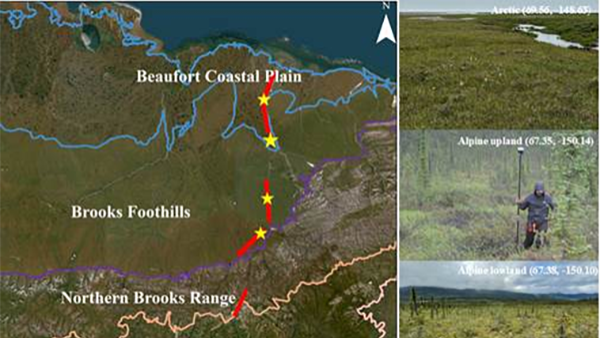
Rapid Arctic warming is reshaping tundra vegetation, yet how plant functional traits vary across landscapes and respond to environmental conditions remains poorly understood. This dissertation integrates field measurements with drone-based and airborne hyperspectral imagery to investigate the spatial distribution, environmental controls, and above- and belowground coordination of plant functional traits across Arctic Alaska.First, a multiscale remote sensing framework was developed to map plant functional traits while preserving fine-scale variability within coarser image pixels. Second, analyses revealed that vegetation composition was more strongly associated with trait variation within sites, whereas broader climatic, hydrological, and soil gradients were more informative across sites. Third, extending this framework belowground revealed that leaf–root trait coordination varied among trait pairs and ecoregions, with consistent relationships in dry matter content but weaker coordination among other traits. Local vegetation composition and microtopographic conditions also contributed to variation in these relationships.
Together, these findings highlight the importance of spatial scale and environmental heterogeneity in understanding plant functional strategies and provide new insights into Arctic vegetation responses to environmental change.